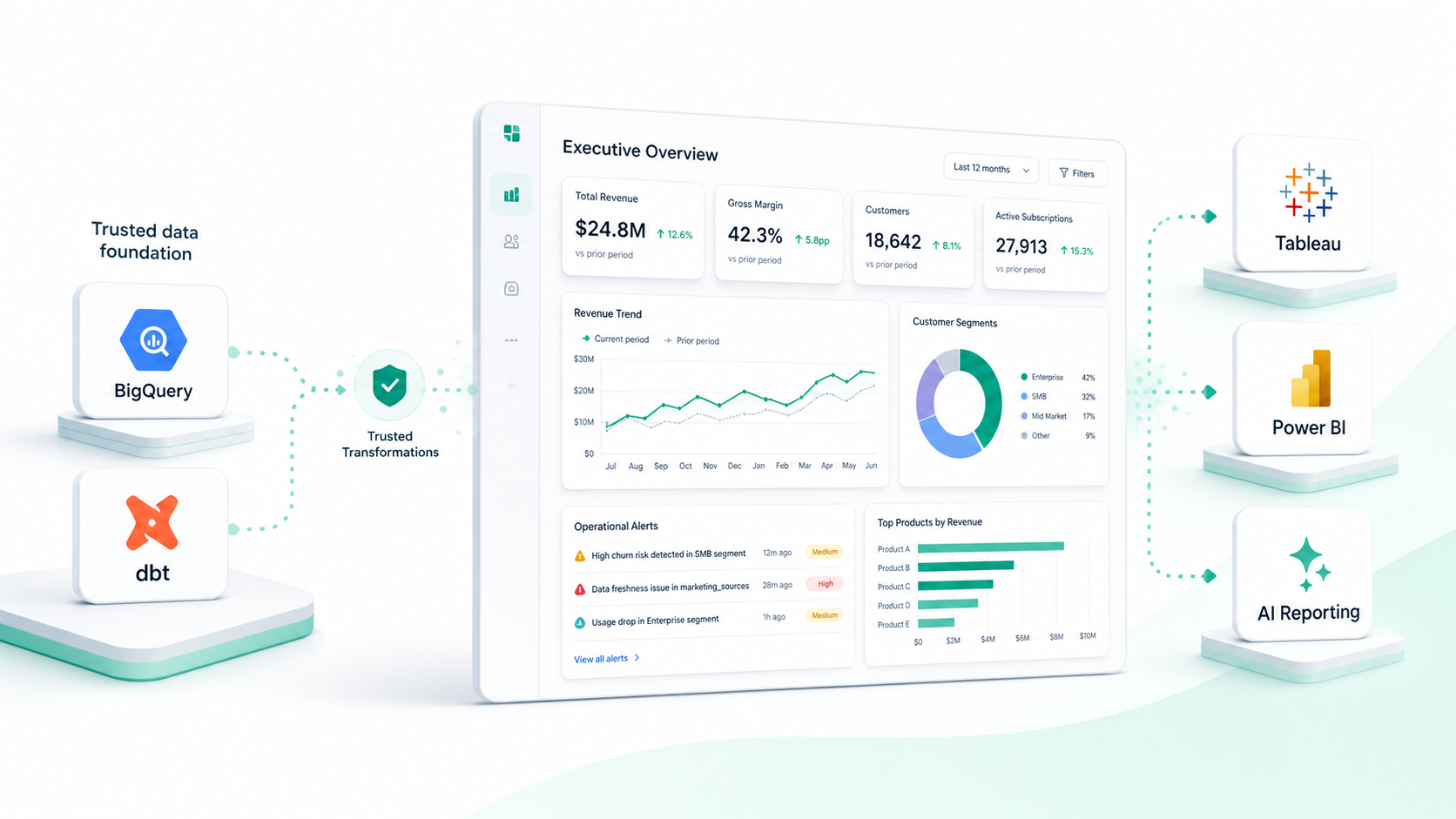
Tableau, Power BI and AI reporting

Tableau Reporting and Dashboard Development in Canberra


We design Tableau-first dashboards, executive reports, and operational reporting that connect cleanly to your BigQuery, dbt, and data engineering foundations. Where the business needs it, we also support Power BI and AI-based reporting.

  • Executive dashboards and operational Tableau-first reporting
  • Workbook performance, UX, storytelling, and adoption
  • Clean metric logic connected to BigQuery, dbt, governed datasets, Power BI, and AI reporting outputs
Tableau Power BI and AI reporting connected to BigQuery and dbt
Canberra Tableau reporting

Dashboards for Canberra teams that need clearer decisions

DataDive builds Tableau-first reporting for Canberra and Australian Capital Territory organisations that need executive dashboards, operational dashboards, workbook remediation, and reporting connected to trusted BigQuery and dbt data foundations.

Executive dashboards, board reporting, and operational scorecards

Delivered by DataDive's remote-first Australian consulting team with clear communication, practical tool expertise, and support across Canberra and Australian Capital Territory.

Workbook rebuilds, performance tuning, and dashboard UX improvements

Delivered by DataDive's remote-first Australian consulting team with clear communication, practical tool expertise, and support across Canberra and Australian Capital Territory.

Metric consistency across Tableau, BigQuery, and dbt

Delivered by DataDive's remote-first Australian consulting team with clear communication, practical tool expertise, and support across Canberra and Australian Capital Territory.

Power BI or AI reporting outputs where the business needs them

Delivered by DataDive's remote-first Australian consulting team with clear communication, practical tool expertise, and support across Canberra and Australian Capital Territory.

Fix slow dashboards, broken data, or reporting issues - without long consulting cycles.

What clients get with DataDive

Tableau workbooks and reporting experiences designed for adoption, trust, and decision speed.

User-first design

Dashboards shaped around user decisions

Lead with the question, not the chart type.

We translate executive, operational, and team-level reporting needs into dashboard flows that help users answer the next question quickly.

Connected stack

Tableau connected cleanly to your data stack

Models, extracts, and permissions aligned to the platform.

We keep Tableau development tightly coupled to source quality, model design, and access control so report logic is not scattered across disconnected workbooks.

Executive clarity

Executive-ready reporting with stronger visual standards

Clean visual hierarchy and fewer competing signals.

We structure layouts, colour, annotation, filters, and navigation so decision-makers can interpret the signal quickly instead of working through clutter.

Production performance

Faster workbooks and less dashboard friction

Performance is part of development, not an afterthought.

We optimise workbook structure, calculations, filters, and extract strategies so dashboards remain responsive as data volume and user counts grow.

Tableau development services

From first dashboards to full reporting estates, we deliver usable Tableau experiences with stronger governance.

01

Executive scorecards and board reporting

Summaries for leadership, not just analysts.

We build concise scorecards and drill-through experiences that let executives move from KPI summary to root cause without losing context.

02

Operational dashboards that support action

Design for daily use, not occasional review.

For sales, customer, finance, and operations teams, we shape dashboards around workflows, exceptions, and the actions users need to take next.

03

Metric definitions and semantic consistency

Keep logic out of one-off workbook hacks.

We help centralise business rules, calculations, labels, and dimensional logic so reporting remains consistent across multiple dashboards and teams.

04

Rebuilds, remediation, and optimisation

Fix what is slow, confusing, or fragile.

We improve inherited dashboards by simplifying logic, reducing workbook bloat, clarifying navigation, and resolving the performance problems that block adoption.

Dashboard domains we build for

We position Tableau around the operating questions each team needs to answer, with practical reporting structures tailored to function, finance stack, and industry context.

Sales dashboards

  • Pipeline coverage, conversion rates, and win-loss trends
  • Account manager performance and territory reporting
  • Revenue pacing, targets, and forecast accuracy

HR and people analytics

  • Headcount, attrition, and hiring funnel visibility
  • Workforce mix, leave trends, and team capacity reporting
  • Leadership reporting for hiring, retention, and utilisation

Operations reporting

  • Service levels, throughput, backlog, and cycle times
  • Exception reporting for delivery, support, and fulfilment teams
  • Operational scorecards designed for daily decision-making

Xero and QuickBooks analytics

  • Revenue, gross margin, expenses, and cash flow tracking
  • Debtors, creditors, payroll, and month-end finance views
  • Finance dashboards shaped for owners, CFOs, and business managers

Retail analytics

  • Sales by location, category, channel, and product mix
  • Inventory movement, margin performance, and promotional impact
  • Store and executive dashboards that surface actionable trends fast

Executive and cross-functional reporting

  • Board-ready KPI packs that bring finance, sales, and operations together
  • Single-source scorecards with consistent metric definitions
  • Clear dashboard storytelling for leadership review and planning cycles

Tableau Development FAQ

Questions about dashboard design, delivery process, and reporting quality.

We begin with reporting discovery, audience mapping, and KPI clarification. Then we define the dashboard flow, wireframe the experience, build against real data, test calculations and interactions with users, and refine the workbook for performance before rollout.

Yes. Many engagements start with inherited workbooks that need redesign, cleanup, or performance remediation. We can rebuild the structure, simplify logic, improve visual hierarchy, and keep the useful parts of the current reporting estate where it makes sense.

We focus on layout, narrative flow, filter behaviour, colour usage, and progressive disclosure. The goal is to reduce noise, surface the most important signal first, and make the next click or decision obvious to the user.

Yes. Tableau development breaks down when source logic is inconsistent, so we often work with warehouse models, semantic rules, and calculation design as part of the delivery. That keeps dashboards aligned and reduces conflicting answers across reports.

We can stay involved after launch to support user adoption, tune workbook performance, add follow-on enhancements, and strengthen dashboard governance as usage expands across the business.

Related services

Strong Tableau delivery depends on clean source models, the right cloud setup, and support after launch.

Related services: